Section regulations, not the monument dealer, decide height, material and base type, and getting the written rules first is what keeps a paid deposit from becoming a rejected stone.
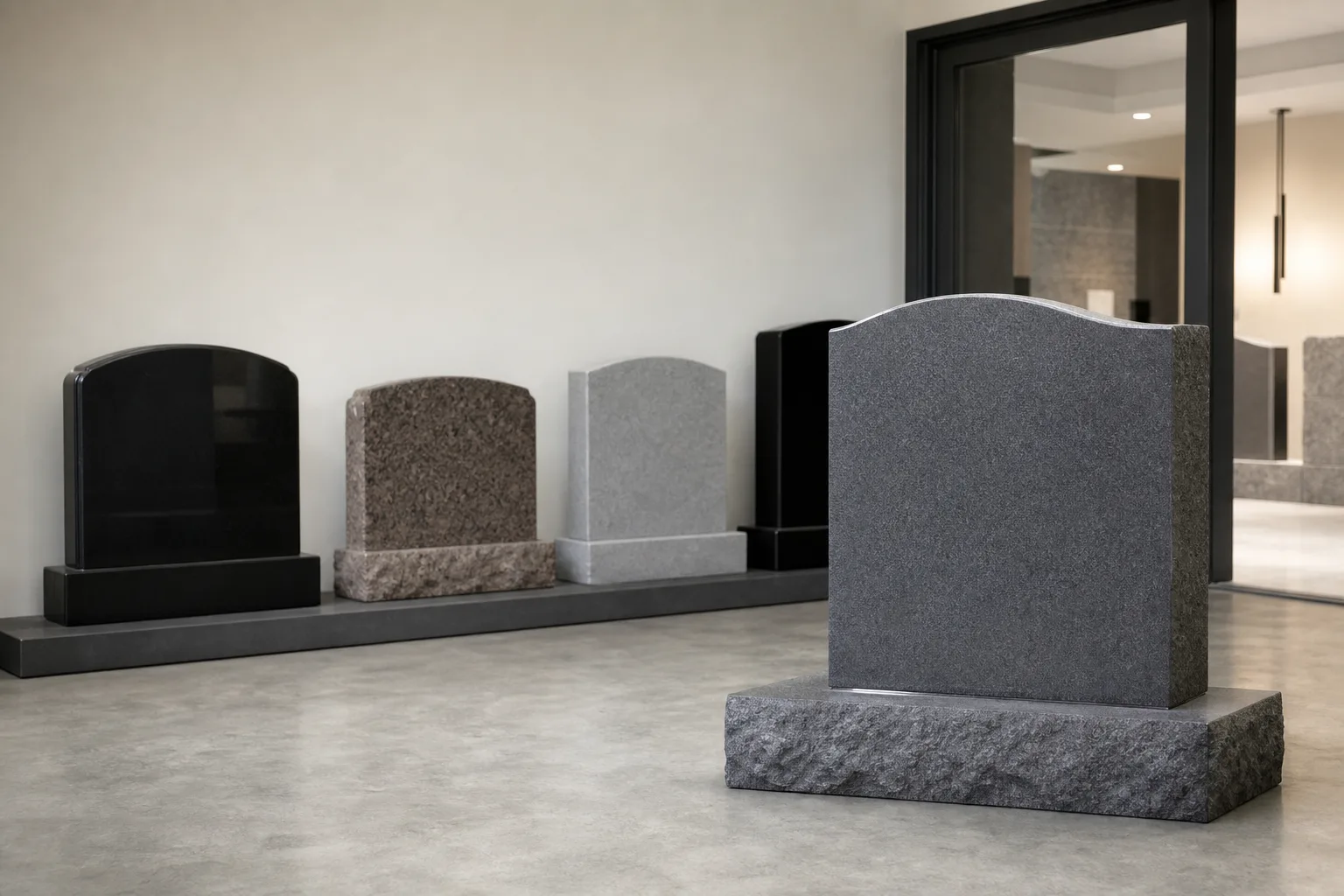
The family had settled on an upright granite marker, dark gray, about thirty inches tall, with a polished front and a rock-pitched edge, and the dealer wrote it up without hesitation and took a deposit of roughly a third. Six weeks later the cemetery superintendent looked at the drawing, turned it around on the desk, and said that the section had gone to flush markers in the early 1970s and no upright had been set there since. Nothing about the plot deed said so. The deed conveyed burial rights and listed nothing else. The rule lived in a two-page document at the cemetery office that nobody had thought to ask for, because nobody had known it existed.
The order the decisions actually happen in
Most people start with what they want the stone to look like, then find a dealer, then discover the constraints one at a time as objections. The sequence that costs less runs the other way. The cemetery's section regulations come first, because they set the outer boundary of every design choice: whether the marker stands or lies flush with the turf, the maximum height and width, the permitted materials, whether a separate granite base is required or forbidden, and how far the stone must sit from the plot line. Only after that does the dealer have a real problem to solve. A dealer will quote whatever you describe, competently and in good faith, because the dealer is not the party enforcing the rules.
What the regulations reach, and how far
Height and footprint are the obvious limits, and they vary not just by cemetery but by section within one cemetery, so an upright standing forty feet away proves nothing about your plot. Material comes next: many grounds allow granite and bronze and quietly exclude marble, limestone and sandstone, sometimes because of weathering and sometimes because the maintenance crew is tired of resetting soft stone. Base requirements are where budgets move the most, since a required granite base can add a substantial fraction to the total and a foundation poured by the cemetery is usually billed separately by the square inch or by the linear foot. A few grounds go further and specify lettering: incised only, no raised letters, no ceramic photographs, no attached vases. Those clauses read as fussy until you understand they are usually about what the mowers can pass over safely.
Getting the written rules and the permit form
Call the cemetery office, ask for the person who approves monument installations, and ask three things in plain terms: the current written rules and regulations for the section your plot is in, the monument permit or setting application form, and the foundation fee schedule. Ask for all three by email as attachments, and ask whether the version they are sending is the one in effect now, because grounds revise these documents and old copies circulate. If the office says the rules are posted at the gate or explained verbally, ask politely for something in writing anyway; a superintendent who will not put the height limit in an email is telling you something useful about how the approval will go. Municipal and county-run grounds often post the regulations online. Religious and private grounds more often keep them in the office, which is not obstruction, only the way small offices work.
The permit form itself is worth reading before you shop, because it tells you who signs. Almost every ground requires the signature of the recorded owner of the burial rights, not simply the closest surviving relative, and if that owner died in 1988 you have an estate question to resolve before you have a stone question. Bring the deed or interment record to the first conversation. Once the rules are in hand, they become the specification you hand a dealer, and the quote you get back for a cemetery monument can be compared line by line against a competitor's quote for the same permitted object rather than against a different design entirely.
What the sequence is worth in dollars
The cost of doing it backward shows up in four places. A rejected design usually means a restocking or redesign charge, and if the stone has been cut or the lettering sandblasted, the deposit is largely gone, because a personalized stone has no resale value. Second, a family that has already emotionally committed to an upright will often pay a premium to find a section that allows one, which can mean buying different graves. Third, delay has a price of its own, since granite quarries and shops work in lead times measured in months and a rejected order goes to the back of the line. Fourth, and least visible, is the difference between a base you chose and a base you were forced into after the design was fixed.
The Federal Trade Commission is the agency responsible for how funeral goods and services are priced and disclosed to consumers, and the general habit it encourages, getting itemized prices in writing before you commit, transfers directly to monument work even where the ground itself is not covered. Ask the dealer to itemize the stone, the lettering, the base, the delivery and setting, and the cemetery's foundation charge, and ask which of those the cemetery bills you for directly. That last distinction surprises people. It also makes two quotes comparable for the first time.
A family that walks into a monument shop with the section regulations, the permit form and the fee schedule in a folder is a different customer than one who walks in with a photograph. The design conversation gets shorter, the quote gets firmer, and the stone that arrives is the stone that gets set.